

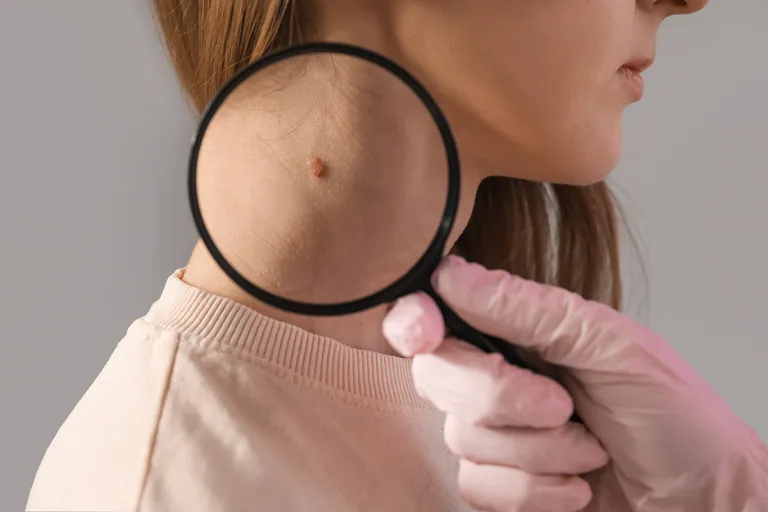
What is Melanoma?
Melanoma is a form of skin cancer derived from melanocytes — skin cells that produce the skin pigment called melanin. The terms "melanoma" and "malignant melanoma" are used interchangeably. Melanoma is the most aggressive form of skin cancer, and can spread (metastasize) to other organs.
Every year, the number of confirmed melanoma cases around the world rises. It mostly occurs in adults, and very rarely appears in children. The predisposing factors include: increasing age, history of sunburns, previous malignant melanoma or another type of skin cancer, atypical nevi syndrome, positive family history, multiple melanocytic nevi, lighter skin tones, and immunosuppression. While most melanomas arise de novo, 30% of cases develop from preexisting skin lesions, like lentigines (plural of lentigo or "sun spot") or atypical nevi, so it is not necessarily reassuring if a lesion in question has been present for years.
What Causes Malignant Melanoma?
Malignant melanoma forms when an uncontrolled, uninhibited growth of melanocytic stem cells that have undergone a genetic change takes place. This can be triggered by ultraviolet radiation and other contributing factors. There are several subtypes of malignant melanoma.
Superficially Spreading Melanoma
The most common form, found mostly on the skin of the trunk and the extremities. The lesions are usually flat, asymmetric, and irregularly pigmented. They tend to spread peripherally.
Nodular Melanoma
About 10–15% of melanoma cases. Appears as a fast-growing, brownish or black papule, most frequently found on the extremities.
Lentigo Maligna Melanoma
Lentigo-derived melanoma tends to develop for years on sun-exposed skin, most commonly on the face. It appears as flat, brownish, irregularly pigmented, and spotted macules.
Acral Lentiginous Melanoma
Occurs on the palms of the hands, soles of the feet, or on the nails. This form is more common in those with darker skin tones. Nail melanomas present as linear, brownish or black pigmented lesions seen through the nail plate.
Malignant Melanoma Treatment Options
Malignant melanoma is diagnosed based on the results of a skin biopsy, taken with a margin of healthy tissue. The two most important prognostic measures are the thickness of the lesion and presence of ulceration. Thickness is assessed using the Breslow scale — it measures the depth of the tumor from its most superficial layer to the deepest point of involvement. The thicker the melanoma, the more likely it is to metastasize. For this reason, during a dermatological consultation, local lymph nodes also should be examined. Those which are easily felt should be subject to a biopsy as well. Confirmed malignant melanoma should be surgically excised with a margin of healthy tissue, which depends on the form of melanoma and Breslow thickness. In more widespread, extensive cases, other options are available, including Interferon-2 therapy or various forms of genetic therapy like BRAF and/or MEK inhibitors. Long-term, regular follow-up to watch the progression of the disease is necessary. PS Dermatology & Surgery will thoroughly analyze your particular case and come up with the most effective option possible.